
By Wearablewhiz / Published July 1, 2026 · Updated September 22, 2026
VO2 max, labeled Cardio Fitness on Apple Watch, is one of the strongest predictors of long-term health your Watch tracks. Most people walk past it every day.
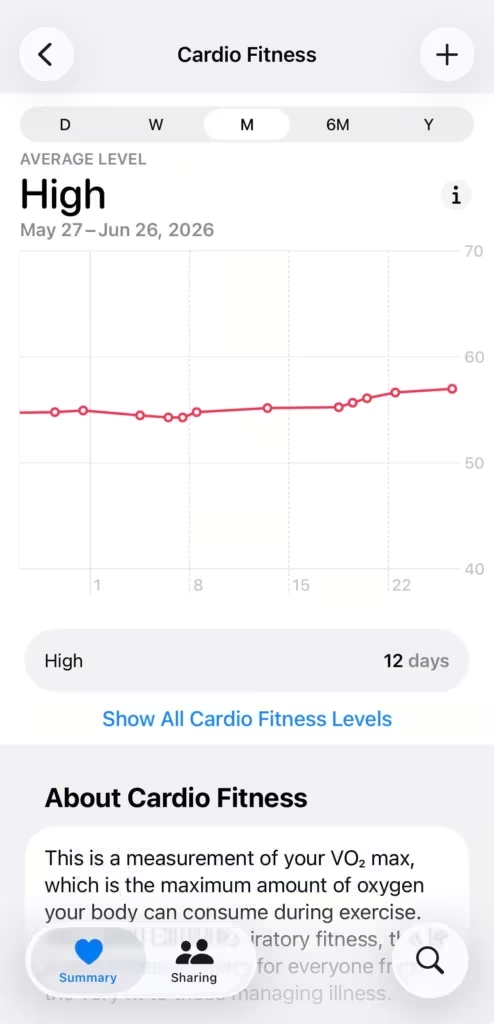
I opened the Health app one morning and saw it right at the top of the summary, before HRV, before resting heart rate. The number said 57. There was a badge next to it: High. I had no idea if that was meaningful, or what I was supposed to do with it.
So I went looking. I read Apple’s validation research and tracked my own number across months of training.
VO2 max is likely one of the most clinically significant number your Apple Watch tracks. Research published in the Mayo Clinic Proceedings found that for every 1 mL/kg/min increase, risk of death drops by 9%. The American Heart Association made cardiorespiratory fitness an official vital sign in 2016. Your Watch estimates it passively, every time you walk or run outside, and most people never check it.
Why VO2 max matters more than almost any other metric
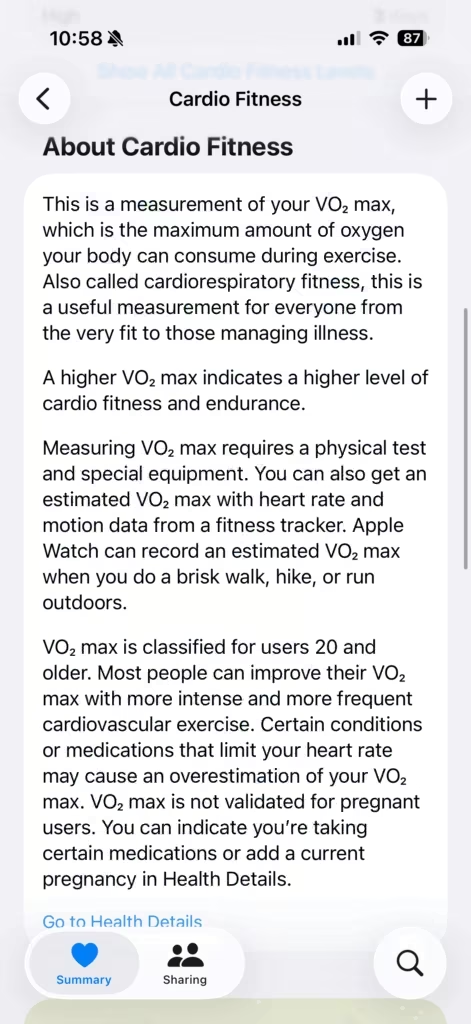
VO2 max is the maximum amount of oxygen your body can consume during exercise. The higher it is, the more efficiently your cardiovascular system delivers oxygen to working muscles.
Here’s the practical version: people with high VO2 max feel comfortable at efforts that gas out people with lower numbers. They recover faster between hard bouts. They have more physiological reserve.
But the real reason to care isn’t performance, it’s longevity. Research across multiple large cohort studies shows VO2 max is one of the strongest independent predictors of cardiovascular and all-cause mortality. Stronger, in some of those studies, than blood pressure, cholesterol, or smoking status. A 2016 American Heart Association scientific statement formally advocated for cardiorespiratory fitness as a vital sign.
A 2016 Mayo Clinic Proceedings study by Laukkanen et al. found that each 1 mL/kg/min higher change in VO2 max was associated with about a 9% lower risk of death. Apple Watch estimates cardio fitness from outdoor walks, runs, and hikes, so it can track that metric over time
How Apple Watch estimates your VO2 max
Apple Watch doesn’t measure VO2 max directly. No wrist-worn device can. Actual VO2 max testing requires a lab, a treadmill or stationary bike, and a mask that captures what your lungs are exchanging with the air.
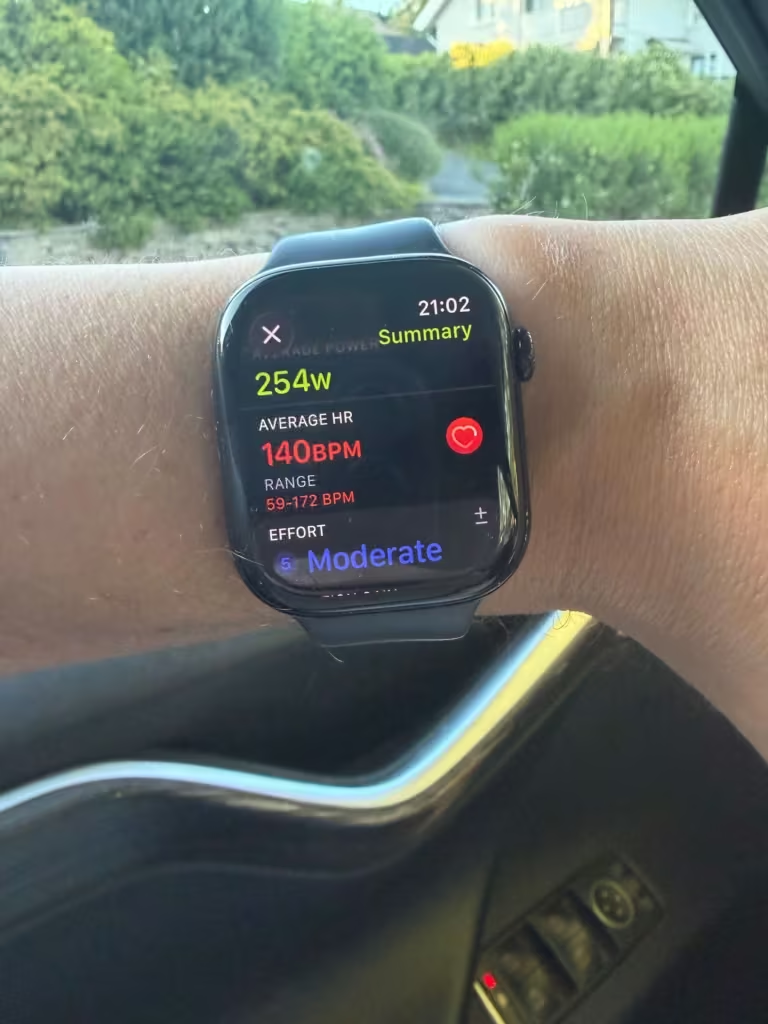
What Apple Watch does is estimate it from your heart rate response to outdoor physical activity. During an Outdoor Walk, Outdoor Run, or Hiking workout, the Watch uses the optical heart sensor, GPS, and accelerometer to model how hard your cardiovascular system is working relative to the effort. It derives your VO2 max from that relationship.
For an estimate to generate, the workout type must be Outdoor Walk, Outdoor Run, or Hiking. Indoor workouts don’t count – treadmill, stationary bike, gym sessions, none of them contribute.
Terrain matters too. The ground needs to be relatively flat: less than 5% grade. A hilly route throws off the GPS-based effort calculation and can suppress or skip an estimate entirely.
Your heart rate also needs to climb. The Watch is looking for approximately 130% of your resting heart rate. A casual walk where you stay comfortable throughout won’t produce a reading.
How accurate is it, really?
Apple’s supported VO2 max range is 14 to 65 mL/kg/min. Apple’s own 2021 validation study, run against cardiopulmonary exercise testing on Apple Watch Series 4, reported an average error of about 1.4 mL/kg/min with a reliability coefficient (ICC) around 0.86. That’s Apple’s number, from Apple’s study, on Apple’s own hardware.
Independent researchers have tested it since, and the results aren’t as clean. A 2025 study in PLOS One tested Apple Watch Series 9 and Ultra 2 against gold-standard indirect calorimetry in 28 people and found the watch underestimated VO2 max by an average of 6.07 mL/kg/min, with a mean absolute percentage error of 13.3%. A separate 2024 study on the Apple Watch Series 7, published in JMIR Biomedical Engineering, found even weaker agreement: an ICC of 0.47, which the authors classified as poor reliability, and accuracy that got worse specifically for people at the fitter end of the range.
None of this means the number is useless. It means you should treat the absolute value with some skepticism and pay more attention to your own trend over time than to whether today’s reading says 42 or 45. The watch is more consistent at tracking your direction than your exact number.
I’ll flag one thing here that I haven’t independently verified beyond Apple’s own materials: Apple’s validation study states that in participants on heart rate-limiting medications (beta blockers, some calcium channel blockers), error dropped from 11.8 to 1.6 mL/kg/min once those medications were logged correctly in the Health app. I’m relying on Apple’s own reported figures for this specific claim, since I haven’t found an independent study that tests it. If this applies to you, it’s still worth entering your medications in the Health app, but treat the exact numbers as Apple’s, not independently confirmed.

Where to find your VO2 max on Apple Watch
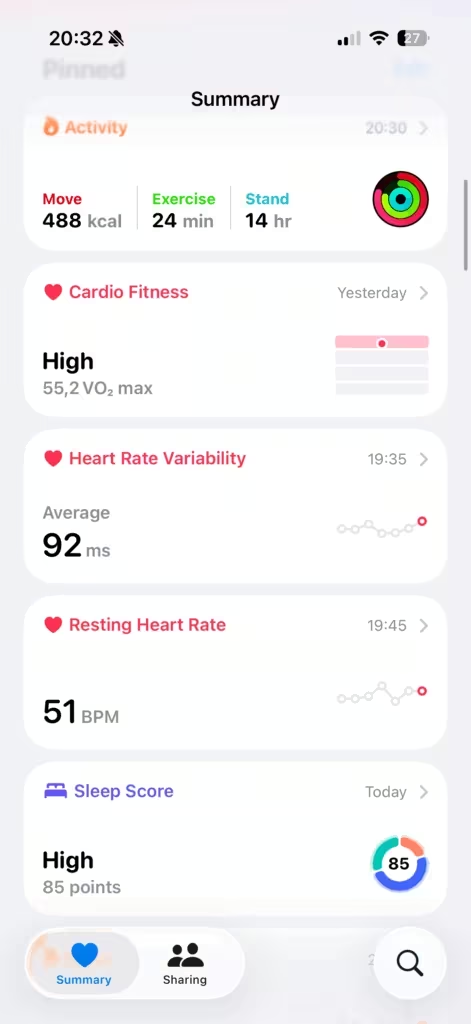
The Health app is where Apple stores your cardio fitness estimates, while Fitness emphasizes trends. That’s why the same metric can look a little different depending on where you view it.
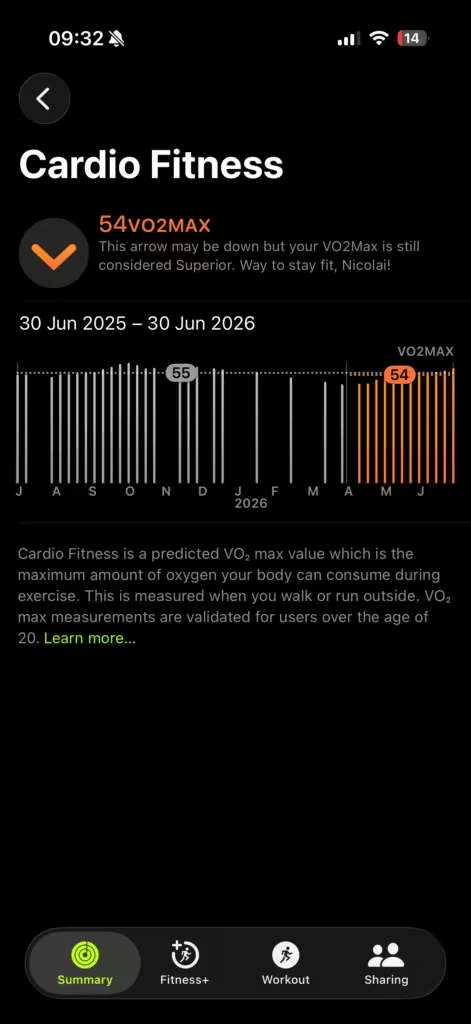
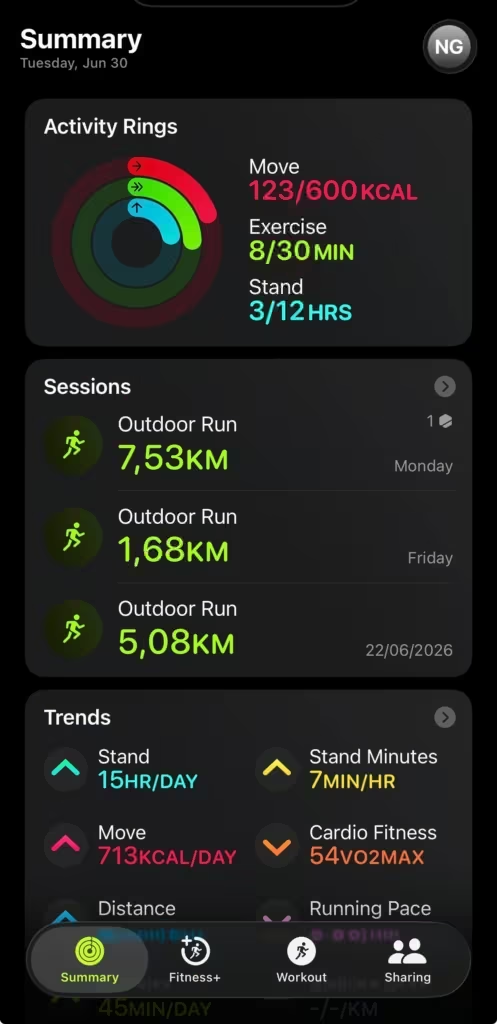
Open the Health app on your iPhone, either tap Search, and type “Cardio Fitness” or enter form the top of the summary view as shown in image below. You can view it by day, week, month, 6 months, or year. Tap “Show All Cardio Fitness Levels” to see how your number compares to your age and sex peer group.
Getting a first estimate takes longer than you’d expect. You need at least 24 hours of wearing the Watch, followed by several outdoor workouts that meet the conditions above. Don’t be surprised if nothing appears for the first week.
Why your Fitness app and Health app show different numbers
The Health app shows your cardio fitness estimates and lets you view them across time, while the Fitness app emphasizes trends, so the numbers can look different. If you see a downward arrow, it usually means your recent trend is lower than your longer-term baseline, not that your watch is broken.
What your classification actually means
Apple classifies your VO2 max relative to people of the same age and sex, using population data from the Fitness Registry and the Importance of Exercise National Database (FRIEND). There are 4 categories:
| Classification | What it means | What to consider |
|---|---|---|
| Low | Bottom quintile for your age and sex. Apple will send a notification if you stay here consistently. | Worth discussing with a doctor, especially with cardiovascular risk factors or a sedentary baseline. |
| Below Average | Below the median for your peer group. Aerobic base has real room to grow. | Consistent aerobic exercise will move this. Give it 8 to 12 weeks of honest effort before judging. |
| Above Average | Better than half your age and sex peers. Solid cardiovascular fitness. | Maintain with regular cardio. Structured training can push it toward High. |
| High | Top of the range for your peer group. Strong cardiorespiratory fitness. | Protect it during periods of reduced training – VO2 max drops faster than most people expect. |
These classifications shift by decade. What counts as above average for a 28-year-old is different from a 52-year-old. Apple adjusts for this automatically. Comparing your number to someone in a different age group tells you very little.
VO2 max also differs between sexes at a population level. Apple factors this in. A woman with a VO2 max of 38 mL/kg/min will typically receive a higher classification than a man with the same number.
What actually affects your reading
A few things that can pull your estimate down, regardless of your actual fitness:
Heat and altitude. Your heart rate runs higher at elevation or in the heat for the same pace. The Watch interprets this as lower fitness than it actually is, because it sees cardiac stress without proportional movement output.
Carrying extra weight. Running with a heavy pack or pushing a stroller increases the work your body does without that registering in GPS. The model underestimates your effort, which means it underestimates your fitness.
Dehydration or caffeine. Both elevate resting and exercise heart rate. Same effect as heat: more heart rate than the movement warrants, pulling your estimate down.
Mostly indoor training. If your workouts are primarily on a treadmill or stationary bike, the Watch doesn’t get outdoor data to update your estimate. It either holds an old reading or shows nothing.
The fix is straightforward: consistent outdoor workouts on flat routes where your heart rate actually climbs.
How to move your number
VO2 max is trainable, but it moves slowly. Two approaches are backed clearly by research:
Zone 2 cardio: long, low-intensity aerobic work at a pace where you can hold a full conversation builds the aerobic base over months. Think 45 to 60-minute runs or rides at easy effort, done consistently 3 to 4 times a week. This is the foundation that everything else builds on.
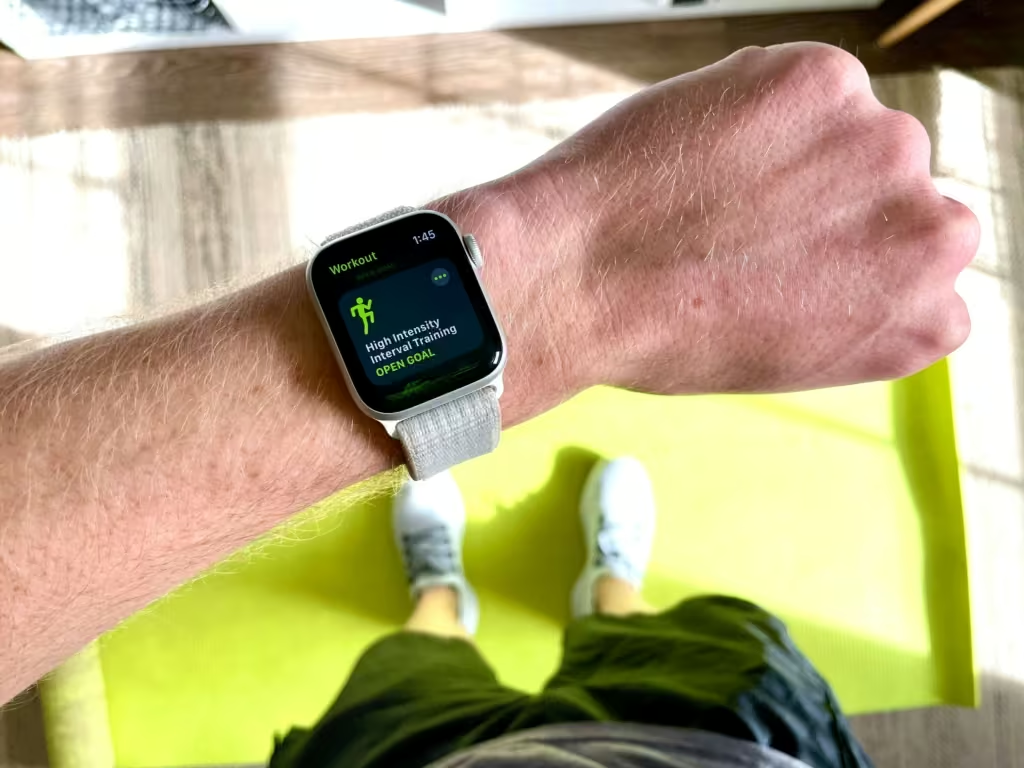
High-intensity interval training yields the largest VO2 max gains per unit of time. Research shows improvements of 5 to 10% over 6 to 12-week HIIT blocks. Most people need a Zone 2 base first, HIIT without it tends to accumulate fatigue faster than fitness.
One thing that surprises people: VO2 max declines quickly with inactivity. Studies have documented drops of up to 27% over just 2 to 3 weeks of rest. It can’t be banked.
The trend line over months is more useful than any single reading. A rising VO2 max across a training block means the aerobic work is paying off. A flat or declining number during heavy training, with load climbing at the same time, is a signal to look at recovery, not add more miles.
This is where VO2 max connects to your other metrics. A rising training load combined with a falling recovery rate and a stagnant VO2 max trend: those signals pointing the same direction is worth taking seriously. Here’s how heart rate recovery works on Apple Watch – it’s the post-workout metric that pairs most naturally with VO2 max for understanding your cardiovascular adaptation.
For pulling all of this together into something you can actually check each morning — VO2 max trend, resting heart rate, HRV, recovery rate – this post on building a daily recovery score walks through exactly how to do that with your existing Watch data.
Training load context fills in the rest. Here’s what Apple Watch training load means and how to read the zones before they become a problem.
The Apple Watch you need for this
You don’t need the newest Apple Watch to track VO₂ max. Apple says Series 3 or later can estimate Cardio Fitness during an Outdoor Walk, Outdoor Run, or Hiking workout. If you’re on a current model, you’re covered.
If you’re buying a watch primarily for this feature, focus less on the model name and more on whether it supports the workout tracking, GPS, and heart-rate features you need. Newer models such as Apple Watch Series 12 add additional health and recovery features, but they are not required for basic VO₂ max estimates.
The takeaway
Apple Watch VO₂ max is not a laboratory measurement, and a single reading should never determine how fit or healthy you are. The estimate can be affected by heat, hills, GPS accuracy, heart-rate data, medication, and the conditions of the workout itself.
What makes it useful is the trend. Look at your Cardio Fitness over several weeks or months, and interpret it alongside resting heart rate, heart-rate recovery, training load, and how you actually feel. A gradual rise usually suggests that your aerobic fitness is improving. A persistent decline is a reason to review your training, recovery, and health, not to panic over one low reading.
Use your Apple Watch VO₂ max as a direction indicator, not a verdict. It cannot tell you exactly how fit you are today, but it can help show whether your cardiovascular fitness is moving in the right direction.
Sources:
- Track your cardio fitness levels – Apple Support
- Using Apple Watch to Estimate Cardio Fitness with VO2 max – Apple Healthcare, May 2021
- Cardio Fitness Notifications Are Available Today on Apple Watch – Apple Newsroom, December 2020
- Importance of Assessing Cardiorespiratory Fitness as a Vital Sign – Ross et al., AHA Circulation 2016
- Long-term Change in Cardiorespiratory Fitness and All-Cause Mortality
- Reference Standards for Cardiorespiratory Fitness – Kaminsky et al., Mayo Clinic Proceedings 2015
- Importance of Assessing Cardiorespiratory Fitness in Clinical Practice
Recent Posts
- Apple Watch readiness score: what the new number actually means
- Apple’s new Health app (2026): what’s actually new and how to use it
- Apple Watch Series 12: what’s actually new (and who should upgrade)
- Apple Watch ECG: what it detects, what the results mean, and when to take one
- Apple Watch blood oxygen (SpO2) explained: what the number means and what to do with it