
My wife wears an Oura Ring 3. I wear an Apple Watch Series 10. Every morning over coffee, we compare what our devices told us overnight.
What started as curiosity has become one of the most useful health experiments we’ve run. And it’s taught us something most wearable reviews miss entirely: the Oura Ring 3 and Apple Watch Series 10 cover completely different parts of your health. Once you get that, the which-one-to-buy question gets a lot easier to answer.


Her experience: Oura Ring 3
My wife has been wearing the Oura Ring 3 for several months. Her average Readiness Score sits around 88 out of 100. She checks it every morning without fail, as automatic as checking the time.
The moment that made her a believer wasn’t a high score. It was the mornings the score dropped into the 60s before she felt anything.
Every time she’s been coming down with a cold, the ring flagged it first. Overnight body temperature would shift, HRV would dip, and her Readiness Score would fall hours before she felt physically off.
“I wake up feeling completely fine, see a Readiness Score in the 60s, and think ‘really?’ Then by lunchtime I understand exactly why it said that.”
The ring has done the same with her menstrual cycle, tracking subtle overnight temperature changes that signal what’s coming. Reliably. Repeatedly. Over months of real daily use.

Her favourite thing is the depth of recovery data. Seven hours of sleep means nothing without knowing the quality. Deep sleep duration, REM cycles, overnight HRV, breathing rate, and body temperature deviation — all synthesised into a single Readiness Score. That depth is beyond what any Apple Watch currently delivers.
Her biggest frustration is workout tracking. When she’s actively exercising, the ring underperforms. No screen to glance at mid-session, and the activity data is less reliable than wrist-based tracking. If real-time workout monitoring is your primary goal, the ring will leave you wanting more.

My experience: Apple Watch Series 10
The Apple Watch Series 10 is the most complete wearable you can buy. Real-time workout tracking, live heart rate zones, GPS, notifications, Apple Pay, ECG, fall detection. It does all of it well. For active workout tracking specifically, nothing at this price point comes close.
I check my sleep score every morning. It’s part of the routine.
But after months of watching my wife use the Oura Ring, I’ll be honest: I’m envious of her Readiness Score. I am constantly trying third party apps to try to find the perfect one. Bevel is the best one I have discovered so far.
I put together a short video on my favorite apps for apple watch here:
The Apple Watch tells me how long I slept and gives me a basic quality indicator. What I can’t get from it is whether my body is actually recovered — whether to push hard in training today or ease off. That single number, built from HRV trends, overnight temperature, sleep consistency, and recovery patterns, isn’t something the Apple Watch gives me. I notice the gap every morning.

What about the Apple Watch Vitals app?
Most comparison articles skip this entirely, so I want to address it directly. The Apple Watch has an early warning feature. Introduced in watchOS 11, the Vitals app monitors heart rate, respiratory rate, wrist temperature, and blood oxygen overnight, sending an alert when multiple metrics simultaneously fall outside your personal baseline.
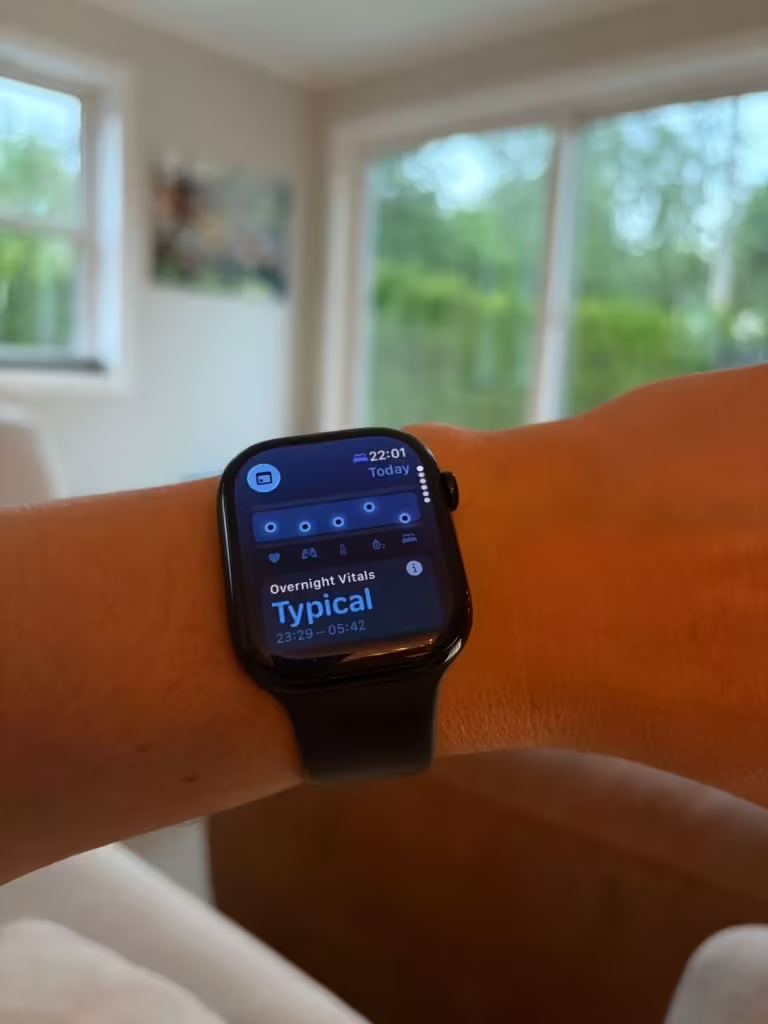
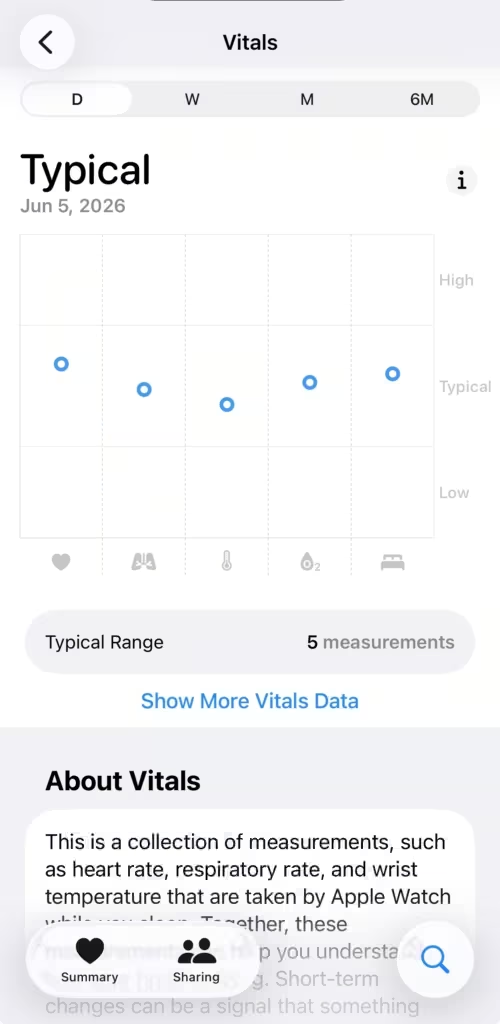
Functionally, the Vitals app does something pretty similar to Oura’s Readiness Score. But in our day-to-day use, Oura just has a much longer track record.
In our house, my wife’s Oura Ring has been incredibly consistent. It catches oncoming bugs and cycle changes every single time, with results she can easily verify. Meanwhile, my Vitals app has been a lot quieter. It definitely does its job when something is obviously wrong, like when it flagged a spike in my wrist temperature and higher resting heart rate while I had a fever. But outside of those major spikes, I’m still figuring out how useful it is for daily, subtle tracking.
My current take: Oura has already proven itself over months of real-world use. The Vitals app is a great, improving feature that handles major alerts well, but it still needs time to prove its worth for day-to-day insights. For example, a drop in HRV in combination with abnormal values in vitals app should be a red flag that should inform me. I feel I have to make conclusions myself by looking at these measurements isolated.
Oura Ring 3 vs Apple Watch Series 10: full comparison
| Feature | Oura Ring 3 | Apple Watch Series 10 |
|---|---|---|
| Sleep tracking depth | ⭐ Best-in-class — deep, REM, HRV, temp | Good — stages tracked, less detail |
| Readiness / Recovery Score | ⭐ Core daily feature, avg 88 | Not available |
| Illness early warning | ⭐ Proven in real use | Vitals app — building track record |
| Cycle tracking (temp-based) | ⭐ Continuous, accurate, consistent | Basic — limited depth |
| Real-time workout tracking | Weak — no screen, data less accurate | ⭐ Excellent — GPS, HR zones, splits |
| Battery life | ⭐ Up to 7 days | ~18 hours — usually charged overnight |
| ECG / medical safety features | Not available | ⭐ FDA-cleared ECG, fall detection |
| Smartwatch features | None — no screen | ⭐ Full — calls, notifications, payments |
| Overnight data coverage | ⭐ 7-day battery — never miss a night | Most people charge overnight — data gaps |
| Comfort while sleeping | ⭐ Feels like a regular ring | Many people remove it at night |
| Works with Android | ⭐ Yes — iOS and Android | iPhone only |
| Price | ~$299 (discounted, check current pricing) + $5.99/month subscription | From $399 — no subscription required |
What living with both actually teaches you
The most valuable insight from months of comparing data isn’t about any specific feature. It’s about timing.
The Apple Watch covers the day — everything you do while you’re awake. The Oura Ring covers the night, capturing the recovery happening while you sleep. Together they deliver 24-hour health monitoring. Separately, each has a blind spot the other fills.
This matters practically. The Apple Watch has an 18-hour battery, which means most people charge it overnight, exactly when the most interesting recovery data occurs. The Oura Ring’s 7-day battery means you wear it continuously, never missing a night, without giving it a second thought.
Who should buy what
Choose the Apple Watch Series 10 if:
- You want one device that handles everything — workouts, notifications, safety, and solid health tracking
- You’re primarily focused on real-time workout performance data
- You value smartwatch convenience, calls, payments, and quick access to information
- You’re on iPhone and want deep ecosystem integration
- You’d rather avoid a monthly subscription
Choose the Oura Ring 3 if:
- Sleep quality and recovery is your primary health goal
- You want a Readiness Score that tells you how recovered your body actually is each morning
- You’re interested in temperature-based cycle tracking or illness early warning
- You want something discreet you can forget you’re wearing
- You already own a smartwatch or don’t need one
Get both if:
- You train seriously and want real-time workout data plus genuine overnight recovery insights
- You want 24-hour monitoring with no data gaps
- Health data is something you actively engage with and adjust your days around
The real cost of running both
Running both costs real money and deserves an honest look.
The Oura Ring 3 is around $299. The Apple Watch Series 10 starts at $399. Oura also requires a $5.99/month membership to unlock the full experience. Without it, the data you receive is too basic to justify the hardware cost. First-year total: roughly $770, with about $72/year ongoing for the Oura membership.
Whether that’s worth it comes down to one question: will you actually use and respond to the data? If you check your Readiness Score and adjust your day based on what it tells you, the investment pays off quickly. If you think you’ll check it for 2 weeks and drift away, pick one device and commit to it fully.
Frequently asked questions
Can the Oura Ring replace an Apple Watch?
No, and it’s not trying to. The Oura Ring has no screen, no notifications, and no real-time workout tracking. It’s a recovery and sleep device. The Apple Watch is a full smartwatch. If you need smartwatch functionality, the Oura Ring can’t replace it.
Does the Oura Ring work with Apple Watch and iPhone?
Yes. The Oura Ring works with both iOS and Android via its own app. It also integrates with Apple Health, so your Oura data can sit alongside your Apple Watch data in one place.
Is the Oura Ring 4 or Ring 5 a better buy than the Ring 3 in 2026?
For most people buying new today, yes. Now two generations old, the Ring 3 has been superseded by a Ring 4 that improved sensor accuracy and redesigned the form factor and a Ring 5 that goes further still, arriving June 4, 2026 at 40% smaller and lighter, fully waterproof (the Ring 3 and 4 are water resistant, not waterproof), with battery life extended to six to nine days. If you find the Ring 3 at a significantly reduced price and the core features – Readiness Score, sleep tracking, HRV, are your primary goal, it still delivers those. But at full price, the Ring 4 or Ring 5 are the stronger choices.
What’s new in the Oura Ring 5 compared to the Ring 3?
The Ring 5 is a meaningful upgrade in both hardware and health features. On the hardware side, it’s 40% thinner, lighter, and smaller than its predecessor, fully waterproof to 100 metres (the Ring 3 is water resistant, not waterproof), and rated for six to nine days of battery life on a single charge. The exterior and interior are both titanium. The Ring 5 starts at $399 for base finishes (Silver, Black) and $499 for premium finishes. The membership remains $5.99/month
On the software side, Oura is rolling out several new features alongside the Ring 5, including Blood Pressure Signals for nighttime blood pressure monitoring, Live Activity Tracking, and AI-enabled care through a partnership with Counsel Health. Worth noting: most of these software features are also coming to Ring Gen 3 and Ring 4, so the Gen 3 in this article, it will receive several of those upgrades too.
One caveat: Blood Pressure Signals and the AI care features are rolling out in June 2026 and are currently limited to members in the US, India, and UAE. They’re also brand new — there’s no real-world track record for them yet, including from us. We’ll update this article as we spend time with Ring 5.
Does Apple Watch Series 10 have a Readiness Score?
No. The Apple Watch doesn’t offer a dedicated Readiness Score. It has sleep scores and the Vitals app for overnight monitoring and alerts, but a comprehensive daily recovery score built from HRV, temperature, and sleep data combined isn’t currently part of watchOS.
What is the Oura Ring monthly subscription for?
The Oura membership costs $5.99/month and unlocks the full suite of insights: Readiness Score, detailed sleep staging, HRV trends, temperature analysis, cycle tracking, and personalised health recommendations. Without it, you get only basic data. The subscription is effectively required to get full value from the hardware.
Disclaimer
I hope you found this post with the insights you need to make an informed decision. At WearableWhiz, my goal is to provide honest reviews, clear, practical, and easy-to-follow information to help you navigate the world of wearable tech. Every article is crafted with care, taking time to research and compile everything so it’s genuinely helpful for readers like you.
Throughout this post, you’ll find affiliate links to products and accessories mentioned. If you choose to purchase through those links, I may earn a small commission at no extra cost to you. This support goes a long way in keeping WearableWhiz running and filled with valuable content. Thank you for being part of this community and supporting what I do!